

courses

Geometric Dimensioning & Tolerancing (GD&T) Training

Days: 2

 7:30 AM- 4:30 PM MST


Overview

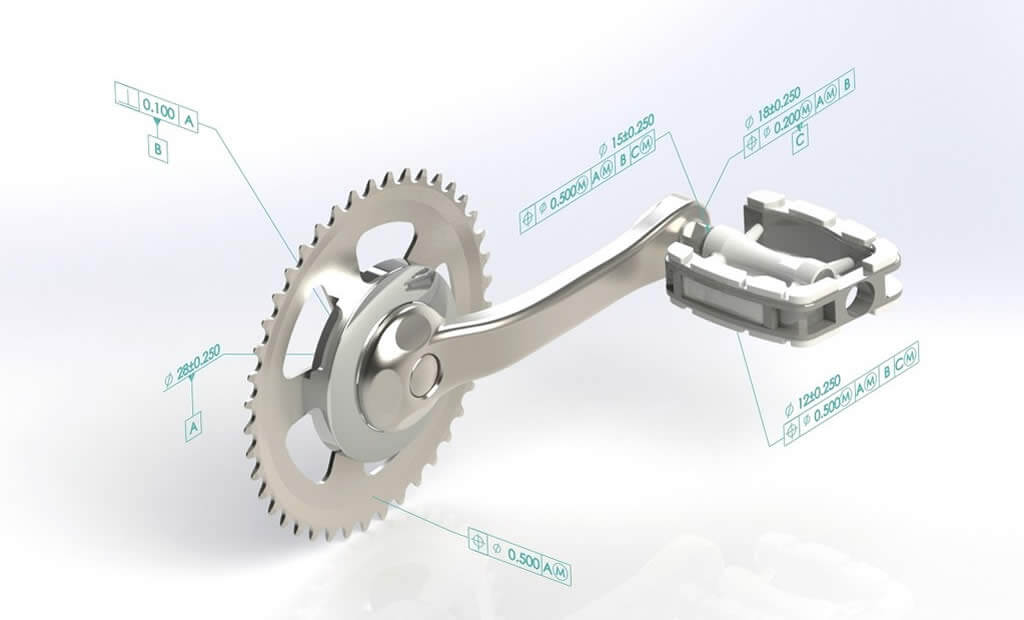
Geometric Dimensioning and Tolerancing (GD&T) is a powerful tool for improving communication, design clarity, and manufacturing efficiency. This two-day course provides a comprehensive introduction to the ASME Y14.5 standard, equipping participants with the practical knowledge needed to interpret and apply GD&T effectively.

The course covers core concepts including datum reference frames, feature control frames, material condition modifiers, and the interpretation of geometric characteristic symbols. Through real-world examples and guided exercises, attendees will learn how GD&T impacts manufacturing processes, inspection methods, and overall product functionality.

In addition to foundational theory, the course walks through the application of GD&T across form, profile, orientation, location, and runout tolerances. Practical discussions include topics such as bonus tolerance, virtual condition, and gaging methods using fixtures and CMMs. Participants are encouraged to bring sample drawings for discussion, allowing for direct application of concepts to real-world scenarios.

By the end of the course, attendees will be able to confidently interpret GD&T on engineering drawings, select and apply appropriate tolerances, and improve communication and quality throughout the product lifecycle.

Prerequisites

Participants should have knowledge of basic blueprint reading in order to be fully successful in this Geometric Dimensioning and Tolerancing training.

Participants also need the ASME Y14.5-2018 Dimensioning and Tolerancing standard. This will not be supplied by Axeon.

Geometric Dimensioning and Tolerancing - Person marking on technical drawings

Who Should Attend

  • Anyone who designs, drafts, engineers, purchases, manufactures, estimates, or inspects parts and assemblies
  • Professionals who use the ASME Y14.5 Dimensioning and Tolerancing standard
  • Quality Managers
  • Engineering Managers
  • Design Teams
  • Management Representatives
  • Project Teams


Geometric Dimensioning and Tolerancing Learning Objectives

  1. Explain the benefits of geometric tolerancing.
  2. Identify datum features and determine their order of precedence.
  3. Identify and interpret each of the characteristic symbols.
  4. Describe the material condition modifiers and how “bonus” tolerance occurs.
  5. Correctly interpret GD&T feature control frames, and explain the impact on manufacturing and inspection.


Agenda

Part 1: Drawings & Dimensioning

    • Importance of engineering drawings
    • Review of traditional dimensioning and tolerancing
    • The need for geometric dimensioning and tolerancing
    • Benefits of using GD&T
    • The GD&T standard: ASME Y14.5
Part 2: Introduction to GD&T Symbols & Terms

    • Definitions
    • Overview of the 12 main symbols
    • Material conditions – MMC, LMC, RFS
    • Reading a feature control frame
    • Sample drawing, with and without GD&T
Part 3: Rules and Concepts

    • Inspecting a part’s size dimensions
    • Rule #1 – size dimensions also control form
    • The pitch diameter rule for screw threads
    • Bonus tolerance
    • Gaging GD&T – fixtures; special gages; CMMs
Part 4: Form & Profile Tolerances

    • Flatness applied to a surface
    • Straightness applied to a surface
    • Circularity
    • Cylindricity
    • Profile of a line, and profile of a surface
    • Straightness and flatness applied to a feature of size
    • Virtual condition calculations
Part 5: Datums

    • Purpose of datums in GD&T
    • Single planar datum
    • How to select datums for a part
    • Simulating datums on gage fixtures and CMMs
    • The datum reference frame
    • Feature-of-size datums (with and without “M”)
    • Common datum features
    • Datum targets
Part 6: Orientation Tolerances

    • Perpendicularity
    • Angularity
    • Basic dimensions
    • Parallelism
    • Tangent plane modifier
    • Profile of a surface revisited: Adding datum references
    • Composite profile
    • Orientation tolerances applied to a feature of size
Part 7: Location Tolerances

    • Location control with coordinate dimensions
    • Definition of “true position”
    • Application of position at RFS
    • Using position with MMC or LMC
    • Application of MMB and RMB on datum features
    • Composite position control
    • Two single-segment position control
    • Projected tolerance zone
    • Calculating tolerance values – fixed and floating fasteners
    • Concentricity – why it is has been deleted from the standard
    • Symmetry – why it is has been deleted from the standard
Part 8: Runout Tolerances

    • Definition of runout – TIR, FIM, coaxiality
    • Difference between runout and other circular controls
    • Circular runout
    • Total runout
Part 9: Applying GD&T to Real Parts & Wrap-Up


Related Courses 

AS9100 Rev D Lead Auditor Training ISO 9001 Lead Auditor Training IATF 16949 Lead Auditor (TS 16949) Training Statistical Process Control (SPC) Training